Darling Downs Hair Transplant Clinic

Hair Transplant Repair and Corrective Hair Restoration

Repair and Restoration

Hair Transplant for
Repair and Corrective Hair Restoration

An unsatisfactory hair transplant can be difficult to live with. You may be concerned about an unnatural hairline, poor growth, visible scarring, low density or a donor area that looks thin or patchy. You may also be unsure whether the result is still developing or whether corrective treatment is needed.

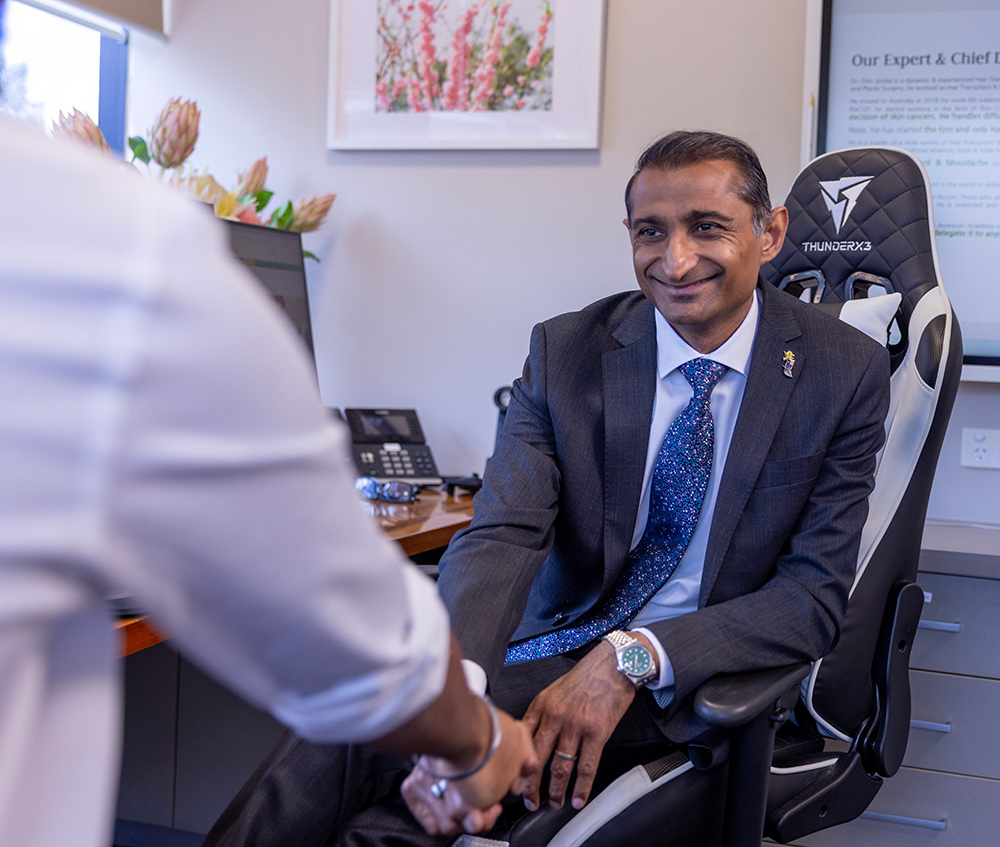
At Darling Downs Hair Transplant Clinic (DDHTC) in Toowoomba, repair cases are assessed by Dr Omi Jindal, a Registered Specialist General Practitioner and Fellow of the Royal Australian College of General Practitioners (FRACGP), with more than 20 years of experience in hair transplantation.

A repair assessment is not a promise of another operation. Its purpose is to identify what has happened, determine whether the result has matured, assess the remaining donor supply and explain which surgical or non-surgical options may be realistic.

Woman with long healthy hair

Quick answer: Many unsatisfactory hair transplants can be improved, but not every result can be fully corrected. The safest plan depends on the original procedure, the time since treatment, the pattern of graft placement, scarring, ongoing hair loss and—most importantly—the quality and remaining capacity of the donor area. 

Do You Need Urgent Care or a Cosmetic Repair Assessment?

If your procedure was recent and you have increasing pain, persistent bleeding, spreading redness, discharge, fever, marked swelling, darkening skin or another rapidly worsening symptom, contact your treating clinic or seek prompt medical care. Do not wait for a routine repair consultation. 

A corrective assessment is different. It usually addresses the appearance of a healed or maturing result, such as hairline design, growth, density, direction, scarring or donor-area depletion. 

Has the Hair Transplant Had Enough Time to Mature?

A result that looks sparse or uneven in the early months has not necessarily failed. Transplanted hairs commonly shed after the procedure, early growth may begin around three to four months, and density and hair calibre often continue to develop for twelve months or longer. 

You can seek an assessment earlier if you are worried. However, elective corrective surgery is often planned only after the original growth and scalp tissues have had adequate time to mature. Acting too early can make it difficult to distinguish delayed growth from a true problem and may expose healing tissue to another procedure unnecessarily. 

Timing matters: An early consultation can clarify what you are seeing and create a monitoring plan. It does not necessarily mean that corrective treatment should be performed immediately. 

Hair Transplant

Why Can a Hair Transplant Look Unsatisfactory?

Repair planning begins by defining the specific problem rather than applying one technique to every case.

  • Hairline design

    A hairline may appear too low, too straight, too broad, too dense or poorly matched to the patient’s age, facial proportions and likely future hair loss.

  • Graft size, angle or direction

    Multi-hair grafts at the leading edge, abrupt density changes or hairs placed against the natural direction of growth can produce a harsh or plug-like appearance.

  • Low or uneven growth

    Coverage may remain thin because of limited graft numbers, variable graft survival, tissue factors, technical factors or progression of non-transplanted hair loss.

  • Donor overharvesting

    Excessive or uneven extraction may leave visible thinning or patchiness at the back or sides of the scalp and reduce the graft supply available for repair.

  • Scarring

    A linear scar may remain after strip harvesting, while FUE produces multiple small extraction scars. Scar visibility varies with technique, healing, hair length, skin characteristics and the number and distribution of extractions.

  • Ongoing hair loss

    A linear scar may remain after strip harvesting, while FUE produces multiple small extraction scars. Scar visibility varies with technique, healing, hair length, skin characteristics and the number and distribution of extractions.

  • Scalp disease or another diagnosis

    Inflammatory, scarring or medical causes of hair loss may need investigation and management before additional transplantation is considered.

What a Hair Transplant Repair Assessment Examines

  • the date, technique and approximate graft number of the original procedure 
  • photographs before, during and after the original transplant, if available 
  • the current hairline, density, graft direction and distribution 
  • the donor area, extraction pattern, scarring and remaining capacity 
  • the stability and likely progression of ongoing hair loss 
  • scalp health and any evidence of inflammatory or scarring disease 
  • your medical history, medications, smoking and healing history 
  • what concerns you most and what degree of improvement would be meaningful 

These findings determine whether observation, investigation, non-surgical camouflage, medical management, a staged repair or no further procedure is the safest recommendation. 

Possible Hair Transplant Repair Options


Possible approach 

What it may address 

Observation and review 

Useful when growth is still developing or the diagnosis and stability of hair loss need clarification. 

Medical hair-loss management 

May help protect or stabilise suitable non-transplanted hair when clinically appropriate; it does not reposition existing grafts. 

Hairline camouflage 

Fine single-hair grafts may soften an abrupt or unnatural leading edge when donor supply and anatomy permit. 

Additional density 

Selected areas of low coverage may be reinforced, but the plan must remain within safe donor limits. 

Selective graft removal or redistribution 

Some conspicuous or poorly positioned grafts may be removed, reduced or repositioned. This can require more than one session and may leave small scars or colour changes. 

Scar camouflage with grafting 

Hair may be placed into selected scars, although growth in scar tissue can be less predictable and the scar is not erased. 

Scalp micropigmentation or styling 

Non-surgical camouflage may reduce the visual contrast of scars or thin areas in suitable cases. It has its own limitations and maintenance requirements. 

Staged combination plan 

Complex cases may require a sequence of observation, removal, camouflage, redistribution or non-surgical treatment rather than one procedure. 

Donor Management Is Central to Every Repair Plan

Donor hair is finite. A previous procedure may have reduced both the number of follicles available and the flexibility to distribute them safely. For this reason, repair planning starts with a donor audit rather than with a desired graft number. 

The plan must balance the area that concerns you now with possible future hair loss and the need to avoid further visible depletion. In some cases, donor limitations mean that only the most noticeable problem can be improved. In others, another procedure may create more harm than benefit. 

What Hair Transplant Repair Cannot Promise

The aim is a proportionate, worthwhile improvement with risks and limitations understood in advance - not a promise of perfection.

  • It cannot restore the scalp to an untouched, pre-transplant state.

  • It cannot guarantee complete scar removal, uniform density or perfect symmetry.

  • It cannot replace donor follicles that have already been removed or permanently damaged.

  • It cannot stop future loss in non-transplanted hair.

  • It may require staged treatment, and each additional procedure creates further healing and scarring.

Repair Process

The Hair Transplant Repair Process at DDHTC

Inside our clinic
Book a free consult
  1. 1

    Initial information and photographs: Provide the date and location of the original procedure, any records you hold, and clear images of the recipient and donor areas. This supports preliminary triage but does not confirm candidacy.

  2. 2

    Clinical assessment: Dr Jindal examines the scalp, identifies the main design or growth problem, assesses donor capacity and considers whether further investigation or observation is needed.

  3. 3

    Options and priorities: You discuss what concerns you most, what can realistically be improved, alternatives to surgery and the consequences of using more donor hair.

  4. 4

    Written plan and quote: If treatment is appropriate, DDHTC provides the proposed sequence, limitations, expected costs and follow-up arrangements.

  5. 5

    Pre-procedure requirements: The clinic explains the current consultation, consent, documentation and cooling-off requirements before any procedure is scheduled.

  6. 6

    Treatment and follow-up: epair may involve one or more stages. Healing and growth are reviewed over time, and further decisions are made only when the response can be assessed.

How Much Does Hair Transplant Repair Cost?

The cost depends on the type of problem, donor assessment, number and complexity of grafts, whether existing grafts need removal, whether scar tissue is involved and whether treatment is staged. A repair cannot be priced responsibly from a generic graft menu alone. 

After assessment, DDHTC provides a written quote for the proposed treatment. Ask what is included, how many stages are anticipated and whether follow-up is covered. Cosmetic hair transplantation is generally not eligible for a Medicare rebate. 

Risks and Limitations of Corrective Treatment

Corrective hair transplantation carries risks that may include pain, bleeding, infection, swelling, altered sensation, poor or uneven growth, shock loss, visible scarring, pigment change, further donor thinning, an unnatural appearance, dissatisfaction and the need for additional treatment. Scarred recipient tissue and previously harvested donor areas may behave less predictably than untreated scalp. 

Your individual risks, the option of no further procedure and any non-surgical alternatives should be discussed before you decide. 

Ready When You Are

Start With a Careful Assessment

If you are concerned about a previous hair transplant, send clear photographs of the hairline, recipient area and donor area, together with the date and any records from the original procedure. The first step is to determine whether the result is still maturing, whether repair appears feasible and what an in-person assessment would need to examine.

Darling Downs Hair Transplant Clinic (DDHTC) · Toowoomba, Queensland · Assessing hair transplant repair patients from Brisbane, the Gold Coast, regional Queensland and interstate.

Frequently Asked Questions

Group 1686567045

Can an unsatisfactory or failed hair transplant be repaired?

Many results can be improved, but the degree of improvement varies. The main determinants are the type of problem, the maturity of the original transplant, scalp health, existing scarring and the quality and remaining capacity of the donor area. 

You can seek advice whenever you are concerned. If the issue is cosmetic rather than an urgent complication, corrective surgery is often deferred until growth and tissue healing have matured—commonly around twelve months or longer—unless there is a clinical reason to act sooner. 

Sometimes. Options may include adding fine single-hair grafts to soften the leading edge, selectively removing conspicuous grafts or using a staged combination. The best approach depends on hairline position, graft direction, scarring and donor supply. 

Selected grafts may sometimes be removed, reduced or repositioned. This is technically demanding, may require several sessions and can leave small scars or colour changes. Removal is not suitable or necessary in every case. 

Donor-area patchiness can sometimes be camouflaged with hair length, scalp micropigmentation or carefully planned grafting, but donor follicles that have already been removed cannot simply be replaced. Further extraction must be approached cautiously. 

Some scars can be made less noticeable with hairstyle changes, scalp micropigmentation or grafting into selected scar tissue. Growth in scars can be less predictable, and no option erases the scar completely. 

No procedure returns the scalp to its untouched state. Some grafts can sometimes be removed or repositioned, but residual scarring, pigment change or altered density may remain. 

Yes. The assessment focuses on your current scalp, donor area and goals rather than where the original procedure took place. Bring any available records, graft counts, operative details and before-and-after photographs. 

It can be. Repair must work around existing grafts, scars, altered tissue and a donor supply that has already been used. It may require finer planning, selective treatment and more than one stage. 

You will be told why. Depending on the problem, alternatives may include observation, medical management of suitable ongoing hair loss, styling, scalp micropigmentation or accepting the current result rather than risking further donor damage or scarring. 

Repair assessments and treatment planning at DDHTC are led by Dr Omi Jindal. Ask the clinic to explain who performs each stage of any proposed procedure so that you can make an informed decision. 

V 4
Our Locations

Two clinics. One trusted Doctor.

Serving patients across Queensland — whether you're local to the Darling Downs or travelling from further afield, we make the process as straightforward as possible.