
Darling Downs Hair Transplant Clinic

Hair Transplant for Gold Coast Patients

Gold Coast Patients

Hair Transplant for Gold Coast Patients:
Doctor-Led FUE in Toowoomba

If you live on the Gold Coast and are considering a hair transplant, DDHTC offers doctor-led follicular unit excision (FUE) at its Toowoomba clinic. The drive is approximately 2 hours 10 minutes from the Gold Coast, although the actual time will depend on your starting point and traffic.

Your care is led by Dr Omi Jindal, a registered specialist general practitioner and Fellow of the Royal Australian College of General Practitioners (FRACGP), with more than 20 years of experience in hair transplantation. Assessment, donor planning, hairline design and the procedure are approached as one clinical plan rather than separate sales and treatment steps.

This page explains who may be suitable for FUE, what the procedure involves, how costs are determined, what recovery usually looks like and how to plan treatment when travelling from the Gold Coast.

Woman with long healthy hair

Quick answer: DDHTC is not a Gold Coast clinic. It is a doctor-led hair transplant clinic in Toowoomba that sees patients who travel from the Gold Coast and other parts of South East Queensland. You can begin with an enquiry and photographs before deciding whether an in-person assessment is worthwhile. 

Gold Coast Patients

Why Do Some Gold Coast Patients Travel to DDHTC?

Choosing a hair transplant provider is not only about distance. It is also about who assesses you, who plans the procedure, whether the donor area is treated as a limited long-term resource, and whether the advice remains realistic when surgery is not the right option. Patients commonly speak with DDHTC because they are looking for:

  • a doctor-led assessment and procedure

  • a conservative, age-appropriate hairline design

  • clear advice about donor capacity and future hair loss

  • a written quote based on their individual treatment plan

  • follow-up with the clinical team after the procedure

  • an honest recommendation, including advice to wait or consider non-surgical management when appropriate

What Does “Doctor-Led Hair Transplant” Mean at DDHTC?

At DDHTC, doctor-led care means that Dr Jindal is personally involved in the clinical decisions that shape your treatment. These include assessing your pattern of hair loss, examining the donor area, discussing the likely progression of hair loss, planning graft distribution and designing a hairline suited to your facial proportions and long-term needs. 

Before choosing any provider, ask who will assess you, who will design the hairline, who will perform each stage of the procedure and what registration or qualifications they hold. You can verify a medical practitioner’s registration on the public Ahpra register. 

Key Points About FUE

What Is an FUE Hair Transplant?

Follicular unit excision, usually called FUE, is a hair-transplant technique in which individual follicular units are removed from the donor area and placed into thinning or balding areas. A follicular unit naturally contains one or more hairs.

The donor area is usually at the back and sides of the scalp, where suitable hairs are more resistant to common pattern hair loss. The grafts are then placed at planned angles, directions and densities to support a natural appearance.

  • The procedure is usually performed under local anaesthetic. You remain awake, although you may feel stinging during anaesthetic injections and pressure or movement during treatment.

  • FUE does not produce a long linear donor scar, but it is not scar-free. It leaves many small, permanent extraction scars that usually become less noticeable once healed and surrounded by hair.

  • The number of grafts that can be moved safely depends on donor density, hair calibre, scalp characteristics, previous surgery and the area requiring coverage.

  • A hair transplant redistributes existing follicles; it does not create new hair or stop ongoing loss in non-transplanted hair.

  • Results develop gradually and vary between individuals. No clinic can guarantee a particular density, growth rate or cosmetic outcome.

Suitable Candidates

Am I Suitable for a Hair Transplant?

Suitability cannot be decided from age or a photograph alone. A proper assessment considers the cause and stability of hair loss, donor-hair quality, scalp health, medical history, previous treatments and whether your expectations match what the donor area can realistically support.

Hair Transplants for Men
Men commonly seek treatment for a receding hairline, frontal thinning, crown loss or a combination of these patterns. Planning must account for possible future loss, not only the area that is thin today. For some younger patients or people with rapidly changing hair loss, stabilisation and review may be more appropriate before surgery.

Hair Transplants for Women
Women may present with a widening part, reduced density, hairline recession or hair loss related to scarring or traction. Diffuse thinning requires careful donor assessment, and some forms of female hair loss need medical investigation before transplantation is considered. Surgery is only discussed when the cause, donor stability and likely benefit have been assessed.

Eyebrow, Beard and Facial-Hair Transplants
Selected patients may also be assessed for eyebrow, beard or moustache transplantation. These procedures require careful selection of grafts and precise control of angle and direction. Because transplanted hairs retain characteristics of the donor scalp, ongoing grooming may be needed.

How Much Does a Hair Transplant Cost?

Hair transplant cost varies because each treatment plan is different. The main factors are the number of grafts required, donor characteristics, the size and location of the recipient area, previous procedures, the technique planned and the complexity of the design. 

After assessment, DDHTC provides a written quote for the proposed treatment. Ask what is included, whether follow-up is covered and whether any additional charges could arise. Cosmetic hair transplantation is generally not eligible for a Medicare rebate. 

For Gold Coast patients: Include travel and, if preferred, overnight accommodation when comparing the total cost and practical convenience of treatment. Price should be considered alongside practitioner involvement, suitability advice, expected graft numbers, follow-up and the limitations explained to you. 

Treatment Journey

The Treatment Journey From the Gold Coast

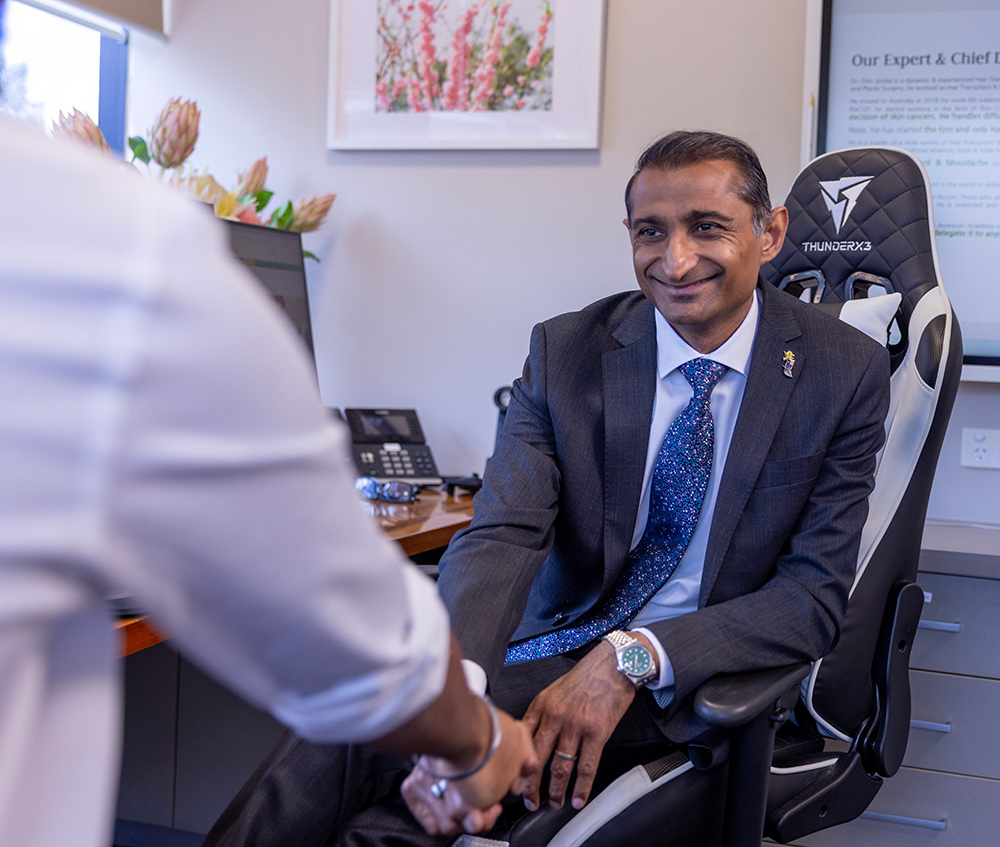
Inside our clinic
Book a free consult
  1. 1

    Initial enquiry: Contact the clinic and provide information about your hair loss, goals, medical history and any previous treatment. Photographs may help with an initial discussion, but they do not replace a clinical assessment.

  2. 2

    Clinical assessment: Dr Jindal assesses the pattern of loss, donor area, scalp and treatment goals. You can discuss FUE, alternatives, limitations, likely graft requirements and whether treatment should proceed now, later or not at all.

  3. 3

    Written treatment plan and quote: If you are suitable, the clinic provides the proposed plan, expected costs and information about risks, recovery and follow-up.

  4. 4

    Pre-procedure requirements: The clinic explains the consultations, documentation, consent process and any cooling-off period that apply before treatment is scheduled.

  5. 5

    Procedure in Toowoomba: Plan for a session lasting several hours, depending on the number of grafts and the treatment plan. Follow the clinic’s advice about transport, medication and whether an overnight stay is sensible. Do not plan to drive if sedating medication is used.

  6. 6

    Follow-up: You receive aftercare instructions and scheduled reviews. Contact the clinic promptly if healing does not follow the expected course or if you develop increasing pain, bleeding, swelling, discharge, fever or another concern.

Hair Transplant Recovery and Growth Timeline


Typical stage What you may notice 
First few days Redness, small crusts, swelling, tightness or tenderness may occur. Follow the clinic’s washing, sleeping and activity instructions. 
First few weeks Many transplanted hairs shed. This is commonly expected and does not necessarily mean the follicles have been lost. 
Around 3–4 months Early new growth may begin, often fine and uneven at first. 
Around 6–9 months More visible growth and thickening usually develop, although progress varies. 
Around 9–12 months or longer The result continues to mature. Crown growth and individual cases may take longer. 

Risks and Limitations

Hair transplantation is an invasive cosmetic procedure and carries risks. These may include pain, bleeding, infection, swelling, altered sensation, poor or uneven growth, visible scarring, temporary shock loss, an unnatural appearance, dissatisfaction with density or design, and the need for further treatment. Individual risks and alternatives must be discussed during consultation. 

A transplant also does not prevent future loss in non-transplanted hair. Long-term planning may include observation or discussion of medical options when clinically appropriate. 

Ready When You Are

Start With a Clinical Assessment

If you are travelling from the Gold Coast, the first step is to find out whether a hair transplant is likely to suit your pattern of hair loss, donor area and long-term goals. Contact DDHTC with your details and photographs to begin the conversation. If an in-person assessment is appropriate, the team can help you plan your visit to Toowoomba.

Darling Downs Hair Transplant Clinic (DDHTC) · Toowoomba, Queensland · Serving patients who travel from the Gold Coast, Brisbane, the Darling Downs and surrounding regions.

Frequently Asked Questions

Group 1686567045

Is DDHTC located on the Gold Coast?

No. DDHTC is located in Toowoomba. This page is for Gold Coast patients who are considering travelling to the clinic for assessment and treatment. 

The drive is approximately 2 hours 10 minutes in normal conditions. Travel time varies with your starting suburb, route and traffic, so check current directions before leaving. 

Yes. You can make an initial enquiry and provide photographs and background information. This may help determine whether an in-person clinical assessment is worthwhile, but photographs alone cannot confirm suitability or a final treatment plan. 

Hair-transplant care at DDHTC is led by Dr Omi Jindal. Ask the clinic to explain who performs each stage of your proposed procedure so you can give informed consent. 

Yes. FUE avoids a long linear donor scar, but each extraction creates a small permanent scar. Visibility varies with healing, skin characteristics, extraction pattern, hair length and the number of grafts removed. 

The number depends on the area being treated, desired coverage, donor capacity, hair characteristics, previous procedures and long-term planning. A graft estimate should follow clinical assessment rather than a photograph alone. 

A natural appearance depends on appropriate patient selection, conservative hairline design, graft choice, placement angle, distribution and healing. Results vary, and a specific cosmetic outcome cannot be guaranteed. 

No. Transplanted follicles may be more resistant to pattern loss, but existing non-transplanted hair can continue to thin. This is why future loss and donor reserves should be considered before surgery. 

Early growth often begins around three to four months. Density and hair calibre usually continue to improve over nine to twelve months, and some areas or individuals may take longer. 

Ask the clinic before making transport plans. The answer depends on the length of the procedure, how you feel afterwards and whether any sedating medication is used. Arrange alternative transport or overnight accommodation if advised. 

Compare who assesses you and performs each stage, the practitioner’s registration and experience, the donor-management plan, how risks and limitations are explained, the written quote, aftercare arrangements and whether the advice remains appropriate if surgery is not recommended. 

V 4
Our Locations

Two clinics. One trusted Doctor.

Serving patients across Queensland — whether you're local to the Darling Downs or travelling from further afield, we make the process as straightforward as possible.